Usersnap PM acquisition & migration
Usersnap had about 1,000 companies paying for its bug-tracking tool when it set out to become a customer feedback platform for SaaS teams. Management’s concern was clear: changing how the product worked could cost the customers who paid the bills.
So we built the new platform beside the old one, aimed it at one persona, the product manager, and let the existing customers move across in their own time. The new platform grew MRR by 500% within six months. 80% of legacy customers migrated within 18 months, and the revenue never stopped while they did.
Don’t lose the base
The pivot meant leaving visual bug tracking for web agencies and moving into customer feedback for SaaS. Usersnap was bootstrapped and profitable, and about 1,000 paying companies relied on the existing tool.
Forcing them onto a new product risked the revenue that was funding the change. Whatever we built had to grow a new market without putting the old one at risk.
Grow the new product beside the old one
Instead of replacing the product, we built the new platform alongside it. The legacy tool, later called Usersnap Classic, kept running unchanged for the customers already on it.
All acquisition effort went into the new platform. That separated two jobs that usually fight each other: growing a new market, and keeping an old one happy.
Build for the persona whose needs contain the others
The research behind the pivot had identified six SaaS personas, from product managers to CX and CS leaders. The new platform was built first for one of them, for three reasons.
Highest incentiveMotivation
Of everyone in a SaaS company, the product manager has the most to gain from feedback about the product, and is the one actively looking for a tool to collect it.
Widest needCoverage
A PM cares about every type of feedback: customer requests, team input, bugs, churn reasons. A product built for the PM covers most of what support, CX, QA and research need as well. The reverse doesn’t hold: build for QA and you don’t get a tool a PM wants.
The door to the companyExpansion
A PM rarely works alone with feedback. Onboarding a product manager meant, sooner or later, onboarding the whole company.
The right users, at the right time, in the tools they already use
Channels and conditionsResearch
I researched which feedback channels product managers were already using, and what conditions they needed to collect the insights they were after: who to ask, at which point in the journey, and in what form.
Which collectors firstPriority
That research decided which feedback collectors to build first, and mapped them to audiences across the funnel, from leadership and the team to users, subscribers and first-time visitors.
Targeting by designConfiguration
It also shaped how collectors are configured, so a PM can target the right users at the right time without writing code.
Integrations that fitEcosystem
Finally, it told us which integrations to build, so Usersnap worked with the tools product teams already had in place instead of asking them to change their stack.
Make the first install the last one
The signup flow asked for the user’s role and goal, set up a first project, and asked them to invite their team. Everything ran on a single code snippet embedded in the product. Once it was in place, each new team could add its own collectors without touching code again: bug reports for QA, surveys for CX, idea collection for product.
When all of a company’s feedback comes in through one snippet, the service becomes part of how the company works. That is what made Usersnap sticky: switching away would mean rewiring every team’s feedback at once.
Earn the move, don’t force it
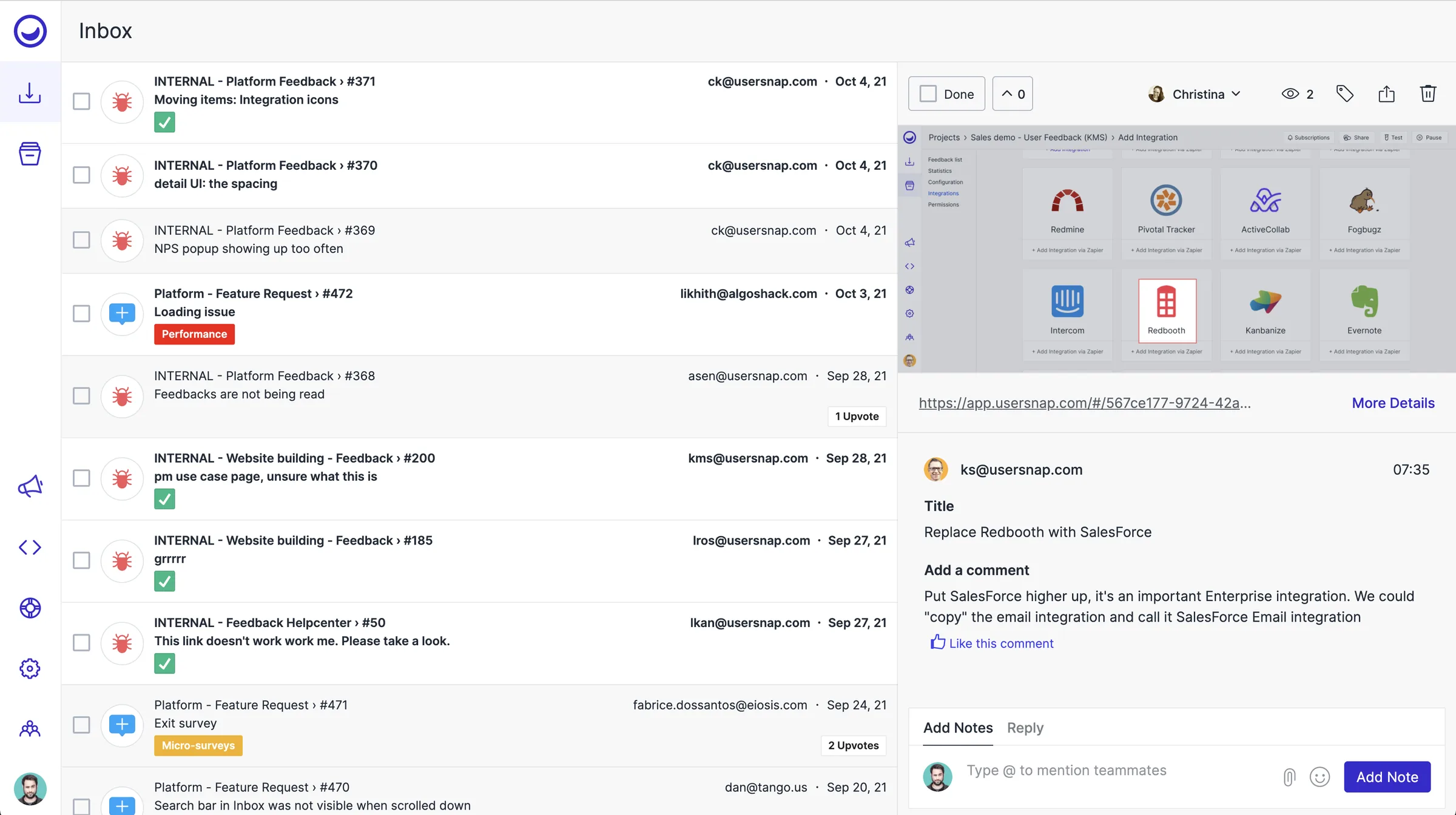
Legacy customers were never forced across. The new platform had to earn the move: a faster inbox for triaging high volumes of feedback, collectors for every team, and integrations that grew from Classic’s 23 to over 2,000 through Zapier. Migrating kept every feedback item and comment intact.
The goal had been to move 60% of customers. Within 18 months 80% had migrated by choice, while the legacy platform’s revenue kept flowing the whole time. Usersnap later phased Classic out at the end of 2021.
- +500% MRRwithin six months of the new platform’s launch
- 80% migratedof legacy customers within 18 months, by choice, against a 60% target
- G2 Leaderin Customer Feedback, 2021
- Acquiredby saas.group in September 2023, with customers including Microsoft, the BBC, Lego, Red Hat and Canva
Grow beside, not instead
Running two platforms costs more in the short term. It also kept the revenue that paid for the new one.
Pick the persona whose needs contain the others
Building for the PM meant building for most of the company. The order matters.
Make the first install the last one
One snippet turned a single sign-up into a company-wide habit.
MRR and migration figures are internal company data from the role. Sources: G2 · Usersnap on the Classic migration · saas.group acquisition